AI Compute Components

AI adoption is accelerating at an ever-increasing pace, and traditional IT infrastructure does not have the capacity AI workloads require. The core components below make AI possible — and must be carefully selected and integrated to hit required performance levels.

High-performance compute cluster illustration
Interactive

The 60-second density check.

The first question we ask every client: do you actually know what your GPUs will demand from the building? Slide the numbers and see — then talk to us before the purchase order.

IT load
6.7 kW
Heat rejection
22.9k BTU/hr
Current @ 415Y/240V 3φ
9.3 A
30A/240V circuits
2
Servers

Built for massive workloads.

The server is the base of the component system. High-performance AI servers use high-density compute architectures with hardware accelerators, large memory, robust cooling, and storage sized for massive datasets. How a server is cooled is now a first-order design decision.

AI server rack illustration

Immersion Servers

Submerged in thermally conductive, non-electrically-conductive dielectric fluid. Heated fluid circulates to a heat exchanger and returns cooled — dramatically improving energy efficiency and hardware density.

Cold Plate Servers (DLC)

Heat is transferred directly from components to liquid-cooled plates. All-metal cold plates are engineered for the hottest silicon — CPUs and GPUs — in a closed loop.

Air-Cooled Servers

Proven, familiar, and still right for many computational and lower-density workloads — when the airflow and inlet temperatures are validated up front.

Supermicro GPU servers

High-performance servers certified by Intel and the Open Compute Project for single-phase immersion cooling. Factory-built, fan-less systems reaching extreme density with PUE near 1.05 — from large-scale training to intelligent edge inferencing.

Up to 10 GPUsUp to 6 TB memoryMultiple CPU optionsNVMe / SATA / SAS10–100 GbE

Optimized for

  • Deep learning & neural network training
  • Medical research and analysis
  • Image and speech recognition
  • Robotics and autonomous vehicles
  • Financial modeling and analysis
SupermicroGIGABYTEHypertecCopal
GPUs

The engines of AI.

GPUs are high-capacity, high-bandwidth processors built for massive-scale training and multi-GPU clusters. Their ability to perform vast numbers of parallel calculations has made them the standard across AI, scientific computing, and analytics.

GPU accelerator chip illustration

Parallel Processing

Thousands of calculations simultaneously — the specialized architecture that accelerates AI and machine learning tasks.

Scalability & Throughput

Scale by adding GPUs; handle huge volumes of data, tasks, and samples within a given timeframe.

Efficiency

Better performance per dollar than CPUs for parallel work — and more calculations per watt of power.

N NVIDIA

NVIDIA dominates the enterprise GPU market as the world's most adopted accelerated computing platform, deployed by the largest supercomputing centers and enterprises — the industry standard for HPC, deep learning, and AI. Fewer, more powerful servers deliver breakthrough performance, faster time to insight, and lower cost.

  • CUDA ecosystem — PyTorch and TensorFlow optimized specifically for it, a deep software moat
  • Tensor Cores — silicon purpose-built for the matrix math behind neural networks
  • NVLink & NVIDIA Quantum InfiniBand — thousands of GPUs working as one supercomputer (DGX GH200 links up to 256 Grace Hopper Superchips into 144 TB of shared memory)
  • NVIDIA AI platform — CUDA, cuDNN-X, and NeMo for building, customizing, and running generative AI models

A AMD

AMD accelerators have made steady progress and now offer competitive performance for many AI training and inference tasks — often with compelling economics. We evaluate both, vendor-neutral, against your workload.

Where GPUs are winning: AI & machine learning · scientific computing · edge & IoT · big data analytics · medical imaging · finance and risk simulation · video editing & 3D rendering · virtual reality.

Networking

Keep the GPUs fed.

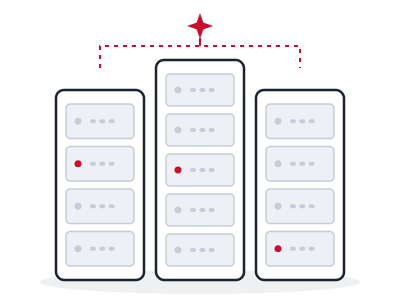
Networks move the huge datasets AI needs between storage and compute — and a bottleneck here leaves your most expensive silicon sitting idle. AI networking must deliver high bandwidth, ultra-low latency, and lossless, predictable connectivity.

AI workloads are fundamentally different from traditional traffic: all-to-all communication where every GPU talks to every other GPU, bandwidth that can quadruple when model parameters double, and sub-microsecond latency requirements for training synchronization.

InfiniBand-class fabricEast-West optimizedAIOps management
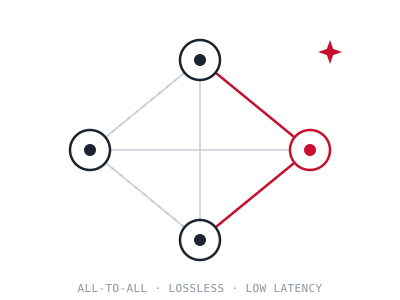
All-to-all AI network fabric illustration

HPE Aruba Networking

Self-driving network solutions with AIOps, agentic AI, and GenAI-powered management in HPE Aruba Networking Central — streamlining configuration at scale with intelligence, resiliency, and security built in.

MT MikroTik

High-capacity hardware purpose-built for AI data clusters, storage fabrics, and high-speed aggregation — plus AI-powered configuration and management, orchestration plugins, and MCP server integrations.
Storage

High throughput. Low latency.

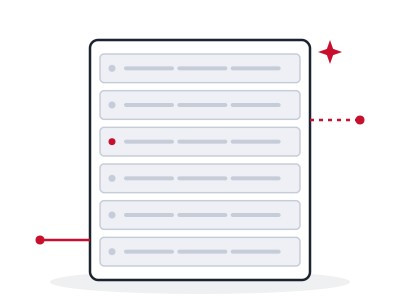
AI storage must manage vast, growing volumes of data while ensuring rapid access at the speed AI models process it. Object storage scales to exabytes for unstructured data; block storage serves fast transactional access; file storage supports simultaneous multi-node access for HPC and parallel file systems.

Benefits our AI storage systems deliver: GPU-accelerated performance, unified file/block/object access, automated data protection, hybrid-cloud integration, simplified management, and cost optimization that eliminates silos and duplication.

Enterprise storage partners →
High-throughput AI storage illustration

H Hitachi iQ

A comprehensive AI stack unifying compute, storage, and data orchestration on one scalable platform for AI, ML, and analytics — wherever the data lives.

  • VSP One — unified block, file, and object architecture
  • All-flash NVMe performance for high-throughput, low-latency AI workloads
  • Built-in cyber resilience — ransomware protection and disaster recovery
  • Pre-validated stacks with NVIDIA, Supermicro, and Red Hat

Q QNAP

Delegate on-premises AI data storage to QNAP NAS — efficient, economical, and highly scalable storage architecture that empowers enterprises to build on-prem AI capability without hyperscaler pricing.

Power

AI-tolerant uninterruptible power.

AI workloads trigger millisecond-level power fluctuations that stress supporting equipment — and demand constant power to prevent expensive data corruption. Modern UPS systems pair high-density lithium-ion batteries with dynamic conditioning and intelligent management. Based on our experience, absent a compelling reason, we generally recommend Eaton.

Uninterruptible power supply illustration

9395 Mission-Critical

Eaton 9395 family — industry-leading efficiency, scalability, and compact footprint for large data centers and multi-tenant facilities, with lithium-ion compatibility for faster recharge and smaller footprint.

93PM End-of-Row

Three-phase white-space solution in 208V and 480V configurations — a low-maintenance, ten-year power platform. Energy-Aware technology can buffer the grid, shave peaks, and return energy to the utility.

9PX Edge & Rack

Double-conversion online UPS at 5–11 kW with over 97% efficiency and remote configuration; 93PX/93PM rack and end-of-row systems scale from 20 kW to 400 kW for GPU-dense white space.

Designing an AI compute build?

We have the knowledge and experience to design, implement, and support your AI infrastructure — regardless of system size — with the best components for your requirements.

Request a quote
(832) 467-0000 · info@nordstargroup.com