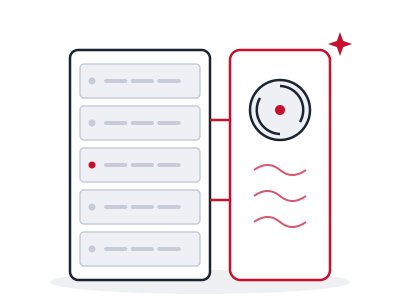
Overheated equipment malfunctions and brings business to a halt. In the AI era, traditional cooling is becoming obsolete — and our data centers have, quite literally, run out of air. We size the system to be cooled and match the best cooling type to it. No single manufacturer or method fits every build.
Independent industry research on liquid immersion cooling in the AI era makes the case in plain arithmetic.
Immersion cooling can also reduce CAPEX build costs by more than 50%, cut footprint by as much as 60%, and repurpose excess heat for facility or district heating. Uniform temperatures eliminate hot spots; removing oxygen and dust extends hardware lifespan.
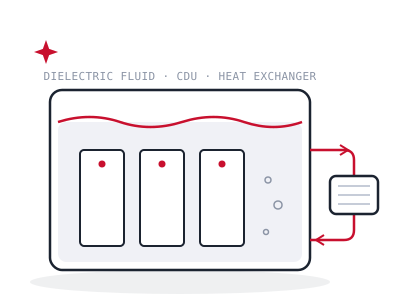
Servers and heat-producing components are submerged in a non-conductive dielectric fluid. As heat transfers to the fluid, a coolant pump cycles it through a heat exchanger and returns it to the tank at a lower temperature — continuously.
What an immersion system needs: a sealed tank or enclosure, dielectric fluid, a coolant distribution unit (CDU), and an external heat exchanger. Purpose-built immersion servers — with chassis engineered for bottom-to-top fluid flow — outperform retrofitted air-cooled hardware on thermal efficiency, maintenance, and reliability.
We work with a leading tank manufacturer specializing only in immersion cooling tanks. Standard sizes come in 12U, 25U, and 50U — and tanks can be custom-manufactured to your exact requirements.
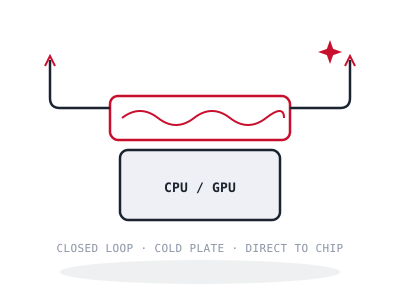
Direct Liquid Cooling (DLC) — direct-to-chip (D2C) — runs a closed loop of coolant through cold plates mounted directly on CPUs and GPUs. The plates absorb heat, a CDU and heat exchanger dissipate it, and cooled liquid returns to close the loop. This can extract up to 80 kW per rack (60–70% of total heat) and cut energy costs by up to 45% — the remaining heat is still removed by air.
Eliminates power-hungry, high-speed fans and air conditioning units, drastically lowering energy consumption and operating cost.
More processing power in a smaller footprint, free of airflow restrictions — and without the fan roar of a traditional data hall.
Liquid transfers heat far faster than air, keeping components stable — and waste heat can be recovered and repurposed.
Sub-millimeter internal channels maximize surface area and drastically lower thermal resistance. Densely packed fins — typically copper for maximum conductivity, or aluminum where weight matters at scale — exponentially improve convective heat transfer.
Arrays of small fluid jets impinge coolant directly onto processor hotspots, breaking down thermal boundary layers. Outperforms standard microchannel designs by 20–40% in thermal resistance — for the hottest, most demanding silicon.
NordStar offers cooling rack solutions from Eaton and Rittal — both exceptional in this space. Eaton's in-rack units are a perfect fit for IT closets and smaller switching centers; Rittal's climate-control concepts scale from a single rack to entire data centers with safety and efficiency at the core.
Beyond that: portable cooling units, in-room precision air conditioners, in-row units between racks, rear-door heat exchangers, rack-top fans, and Eaton SmartRack modular data centers with 12 kW or 25 kW in-row precision cooling.
| System Size | Typical Fit |
|---|---|
| Small · ≤ 5 kW | Computational systems or a small number of GPUs |
| Medium · 5–12 kW | 1–2 racks (42U) up to a complete row of racks |
| Large · 12–25 kW | High-density rows; in-row precision and closed-loop enclosures |
| Beyond 25 kW | The liquid-cooling conversation — DLC or immersion |
Every cooling conversation eventually lands on this table. Open the full comparison — the same one we walk through with every client.
Open the full comparison Ask us which fits your buildWe size the system to be cooled and match the best cooling type to it — immersion, direct liquid, rack, or air.
Request a quote| Feature | Air Cooling | Liquid (DLC) | Immersion |
|---|---|---|---|
| Methodology | |||
| Cooling medium | |||
| Max rack density | |||
| Heat transfer | |||
| Setup cost (CapEx) | |||
| Operating cost (OpEx) | |||
| Energy efficiency (PUE) | |||
| Space efficiency | |||
| Maintenance & risk | |||
| Hardware lifespan |